Compressor fouling: what your heat rate is quietly telling you
A 2% heat-rate drift on a 200 MW frame is roughly 1.4 million dollars of fuel a year. Most of it starts as a thin film on the first three compressor stages.
Fouling almost never announces itself. It arrives as a slow, boring shift in numbers the control room stopped looking at months ago: a slightly higher exhaust temperature, a slightly lower pressure ratio, a fuel flow that creeps up at the same ambient. By the time it is visible on the trend screen as a step change, it has usually been building for 4,000 to 8,000 operating hours.
On a compressor, airborne dirt collects where the air first turns. Stage 1 and 2 rotor blades and the inlet guide vanes take the bulk of it, then the film spreads rearward. The blade profiles are designed around a specific surface condition; when that surface is no longer smooth, the boundary layer thickens early and the whole characteristic changes.
Three signatures worth trending weekly
- Corrected heat rate, normalised to a fixed ambient and fuel composition. A 1% drift is a real cost, not noise.
- Compressor pressure ratio (discharge over inlet) versus corrected speed. Fouling shows up here before it shows up in power output.
- Exhaust temperature spread. A widening spread is the late signal — it means some cans are being pushed to hold firing temperature.
If you only have time for one number, trend the pressure ratio. It is cheap to compute from existing instrumentation, it responds to fouling rather than to ambient, and it degrades in a way that is close to linear with deposit mass.
A typical drift pattern
| Parameter | Clean reference | After 6,000 h | Act at |
|---|---|---|---|
| Corrected heat rate | baseline | +1.0 to 2.5% | +1.5% |
| Compressor pressure ratio | baseline | −1.5 to 3.0% | −2.0% |
| Compressor efficiency | baseline | −0.8 to 1.8 pts | −1.5 pts |
| Exhaust temperature spread | baseline | +8 to 20 °C | +25 °C |
These are typical industrial-frame ranges, not a specification. Your unit's own first-year trend is the only useful reference, which is the argument for capturing a clean baseline in the first 500 hours after an overhaul.
Online wash or offline wash?
- Online (wet compression) wash runs at load with demineralised water injected at the inlet. It removes the soft, water-soluble fraction and can be done weekly. It does not touch baked-on deposits.
- Offline wash requires a crank soak, a heated detergent cycle and a rinse, so it costs you the unit for 6 to 14 hours. It restores the majority of the lost performance.
- The usual cadence is weekly online washes between offlines, and an offline wash tied to your combustion inspection turnaround.
Fouling that has been left for two intervals no longer washes off. That deposit has to be grit-blasted by hand, and that is an overhaul, not a wash.
Commissioning engineer, 250 MW combined cycle
When washing stops helping
If an offline wash recovers less than half the measured drift, you are no longer dealing with fouling. Erosion at the inlet stages, corrosion from salt-laden coastal air, or a mis-set inlet filter house is the more likely cause, and blade replacement or repair is a parts question rather than a cleaning question.
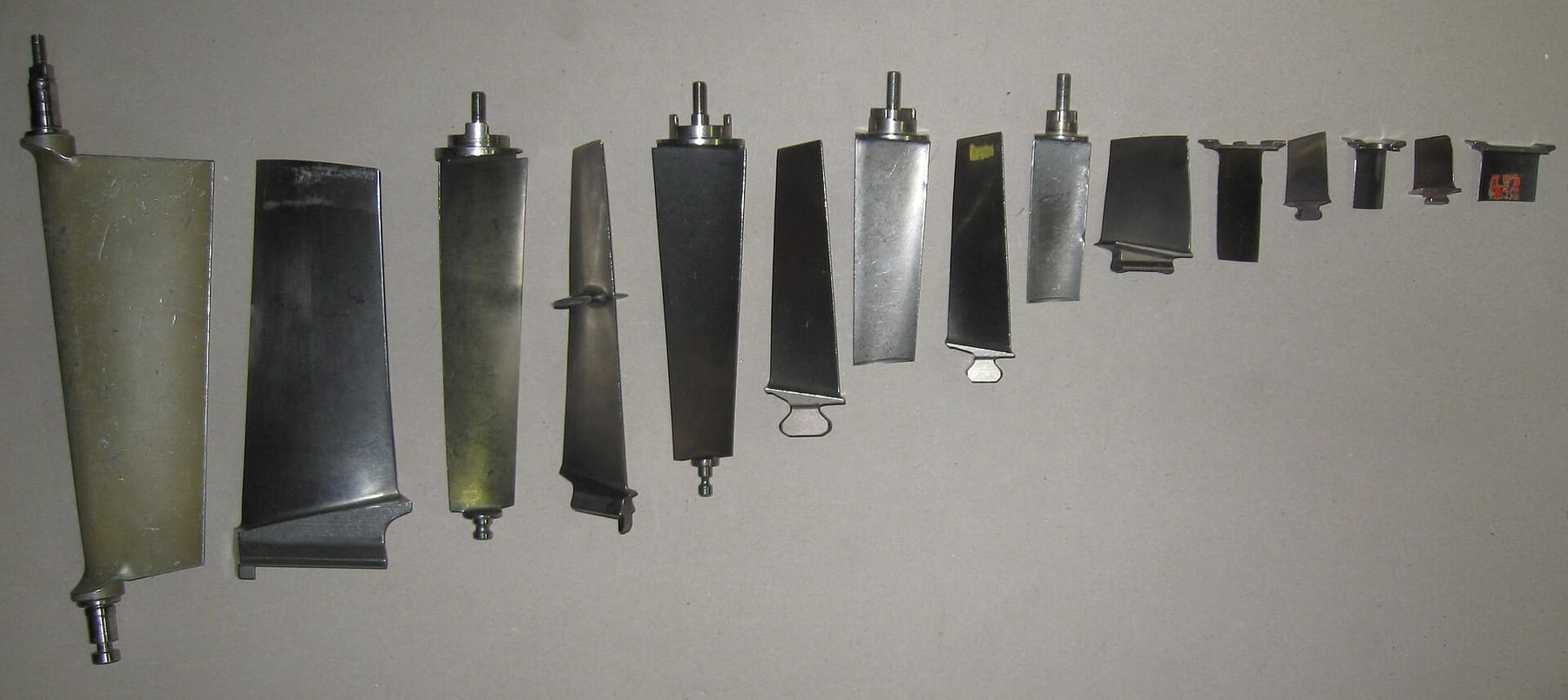
That is the point to bring in a borescope inspection and a stage-by-stage condition report before anything is ordered. Compressor blades and IGVs are stocked items for most industrial and heavy-duty frames; the lead time is usually weeks, not months, provided the part number is confirmed from the rotor assembly drawing rather than from a photograph.
- Compressor
- Heat rate
- Washing